A/C compressors, condensers, evaporators, heater cores, blower motors and expansion valves to General Motors original specification.
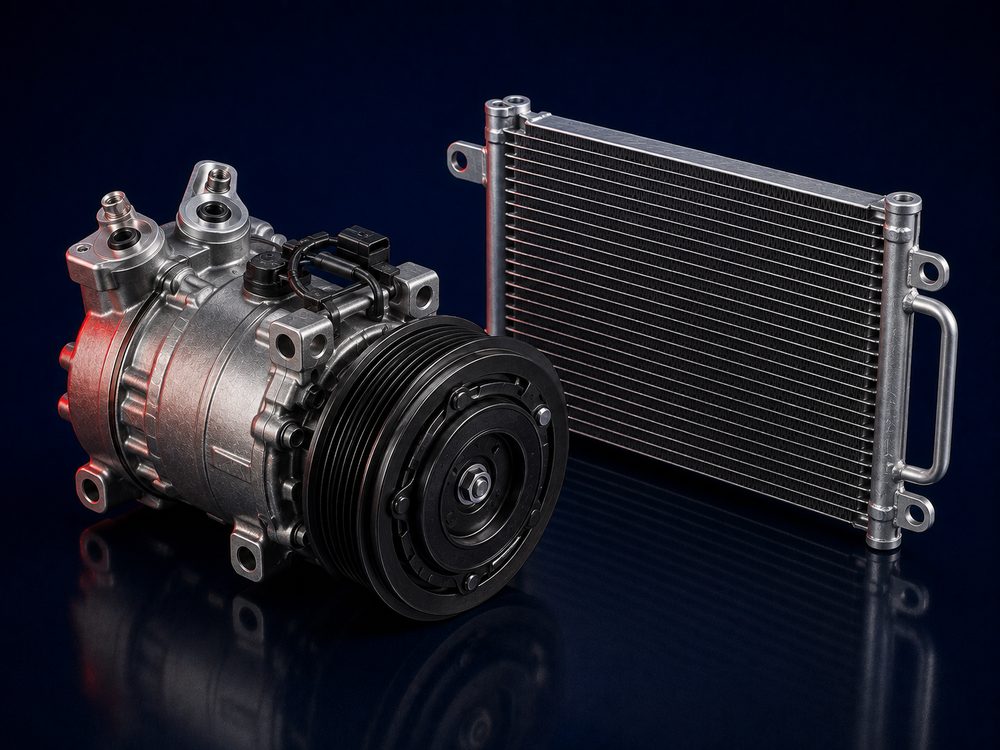
Air conditioning is a closed system, and its components fail as a chain. When a compressor seizes it distributes metal debris through the condenser and the expansion device, which is why replacing the compressor alone so often ends in a second failure. GM specifies compressor displacement, control valve behaviour and refrigerant charge weight together. We supply climate control components to the original specification, and can supply the matched receiver-drier or accumulator that must be replaced whenever the system is opened.
The compressor raises pressure, the condenser sheds the heat, the drier strips moisture, the expansion valve drops the pressure, and the evaporator pulls cabin heat into the refrigerant. Cold, dry air at the vents.
Interactive schematic — behaviour illustrated for orientation, not a model-specific engineering drawing.
The refrigerant loop is sealed. Any repair that opens it must end with evacuation and a measured recharge, not a top-up.
Whenever the refrigerant circuit is opened, the receiver-drier or accumulator must be replaced. Its desiccant saturates within minutes of exposure to air, and reusing it puts moisture back into a freshly repaired system.
We supply A/C & Heating components across every General Motors division:
If the compressor failed internally, yes. Debris lodges in the condenser's narrow parallel-flow passages and cannot be flushed out reliably. It will migrate into the new compressor.
Usually a blocked evaporator drain rather than a leak. If the fluid is sweet-smelling and slightly oily, it is coolant from the heater core instead, which is a different repair.
Send the VIN and a description. We will identify the correct OE part and quote it back to you.
Request a Quote