Struts, shock absorbers, control arms, ball joints, tie rods, bushings and wheel hub assemblies to General Motors original specification.
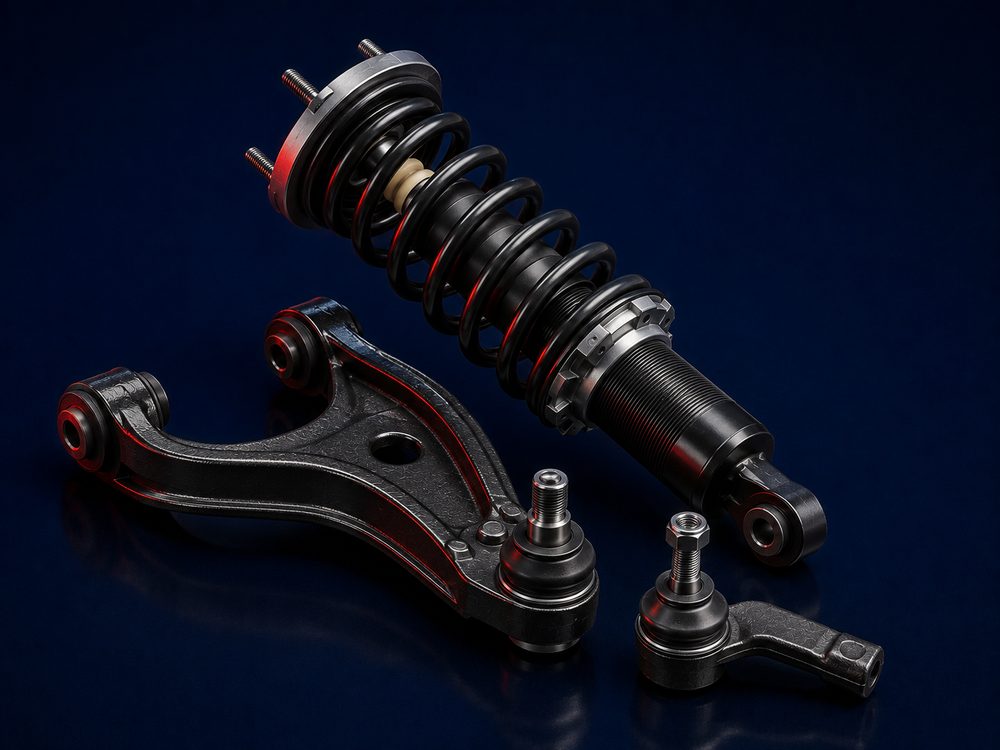
Suspension geometry is engineered, not assembled. Bushing durometer, ball joint preload and control arm bush bore position determine where the wheel sits through its travel, and therefore how the vehicle tracks, how the tyres wear and how the electronic stability system interprets what the vehicle is doing. Softer aftermarket bushings feel acceptable on delivery and let geometry drift under load within a year. We supply steering and suspension components to the original GM specification, including hub assemblies with the correct integrated speed sensor.
Steering input travels through the gear, tie rods and knuckle to the contact patch with no lost motion, while the hub bearing carries the load in silence. The car goes exactly where it is pointed.
Interactive schematic — behaviour illustrated for orientation, not a model-specific engineering drawing.
Suspension geometry is a chain: one worn ball joint or bushing changes camber and toe at the contact patch and wears tyres unevenly.
Replace suspension components in axle pairs where the joint carries load. A new strut opposite a worn one produces a corner-to-corner imbalance that the stability control system will read as a persistent yaw offset.
We supply Suspension & Steering components across every General Motors division:
On most modern GM platforms, yes. The bearing, hub flange and speed sensor are supplied as a sealed assembly and are not serviceable separately.
Any part that positions the wheel — control arm, tie rod, knuckle or ball joint — requires a four-wheel alignment afterwards. Struts on strut-type front suspension also affect camber.
Send the VIN and a description. We will identify the correct OE part and quote it back to you.
Request a Quote